Tribe Money
Overview
Tribe Money is a fintech web application designed to help groups (e.g. college clubs, sports teams, and affinity organizations) collect, manage, and distribute shared funds more transparently and efficiently. This was a sponsored capstone project in collaboration with Tribe Money Pools.
My role: UX Researcher & Designer, Product Manager
Timeline: 20 weeks
Team: Capstone product team (5 people)
Stakeholders: Tribe Money team, supervising professors, users
Problem
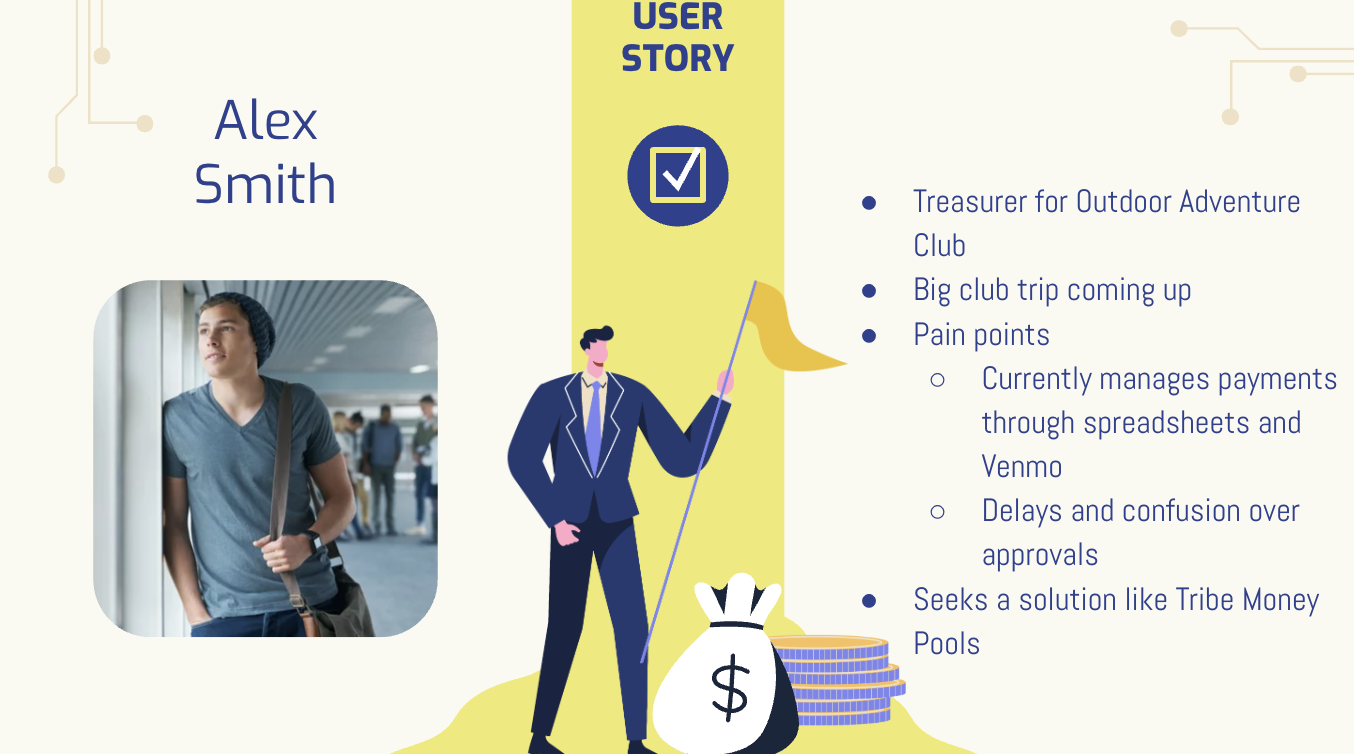
Tribe Money had already developed a mobile application for managing shared funds within groups, but many administrative tasks, such as budgeting, tracking contributions, and reviewing transaction history, are better suited to larger screens. Group financial coordination is often fragmented across tools like Venmo, spreadsheets, and messaging platforms, creating confusion, delays, and limited transparency around shared funds. Treasurers and organizers frequently manage payments manually, which increases administrative burden and introduces trust concerns when one person is responsible for pooled money.
Opportunity
The team identified an opportunity to design a web application that complements the existing mobile experience while supporting more complex financial management workflows. The challenge was to design a web experience that preserved the visual identity, interaction patterns, and trust signals of the existing mobile product while taking advantage of the additional screen space to support planning, oversight, and financial visibility. Beyond research and design, the engineering team was responsible for building the web application end-to-end, requiring close collaboration to ensure the interface remained technically feasible while still meeting user needs and business goals.
Research Approach & Rationale
I conducted semi-structured qualitative interviews to explore how groups manage shared finances and uncover underlying pain points. A qualitative approach was chosen to gain deeper insight into user behaviors, motivations, and unmet needs that quantitative data would not capture. I interviewed stakeholders, current users, and group organizers (e.g., treasurers of college clubs and community groups), focusing on individuals responsible for managing funds due to their direct experience with coordination challenges. Participants varied in group size, roles, and financial responsibility, providing a range of perspectives. Interviews followed a flexible guide covering current workflows, pain points, and expectations for a web-based solution, allowing for both consistency and deeper probing.
Identified pain points:
Tracking payments across Venmo, spreadsheets, and checks
Delays in collecting funds and reimbursements
Lack of transparency around budgets and contributions
Trust concerns when one person manages pooled money
Difficulty coordinating across multiple communication channels
Market and literature review research showed that:
Trust and security strongly influence adoption
Clear communication and transparency improve retention
Visual design impacts perceived safety in financial apps
Key Insights & Research Impact
Users demand centralization
Users managing group finances often rely on multiple tools simultaneously (Venmo, spreadsheets, messaging apps, and email). This fragmentation creates confusion, delays, and extra administrative work.
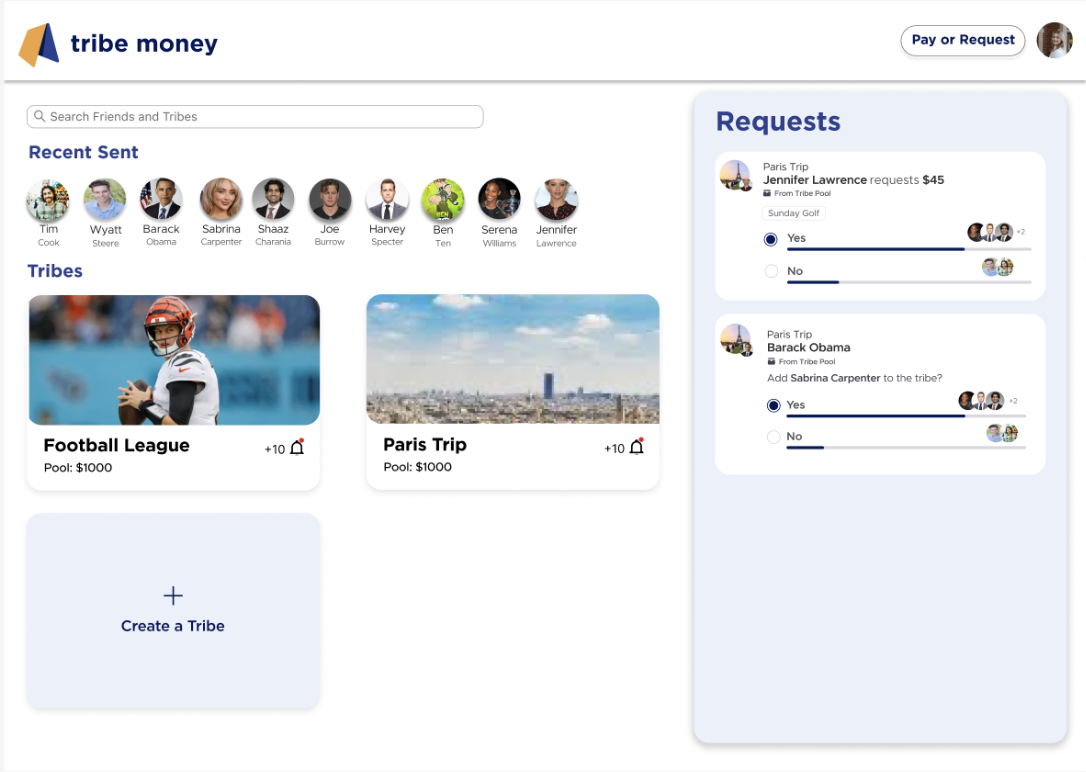
Design Impact: Dashboard-centered experience that consolidates transaction history, active requests, pooled funds, and group activity into a single view.
Transparency is Key
Managing shared money requires visibility into how funds are collected, stored, and spent. Users want to know who contributed, what requests exist, and how decisions are made.
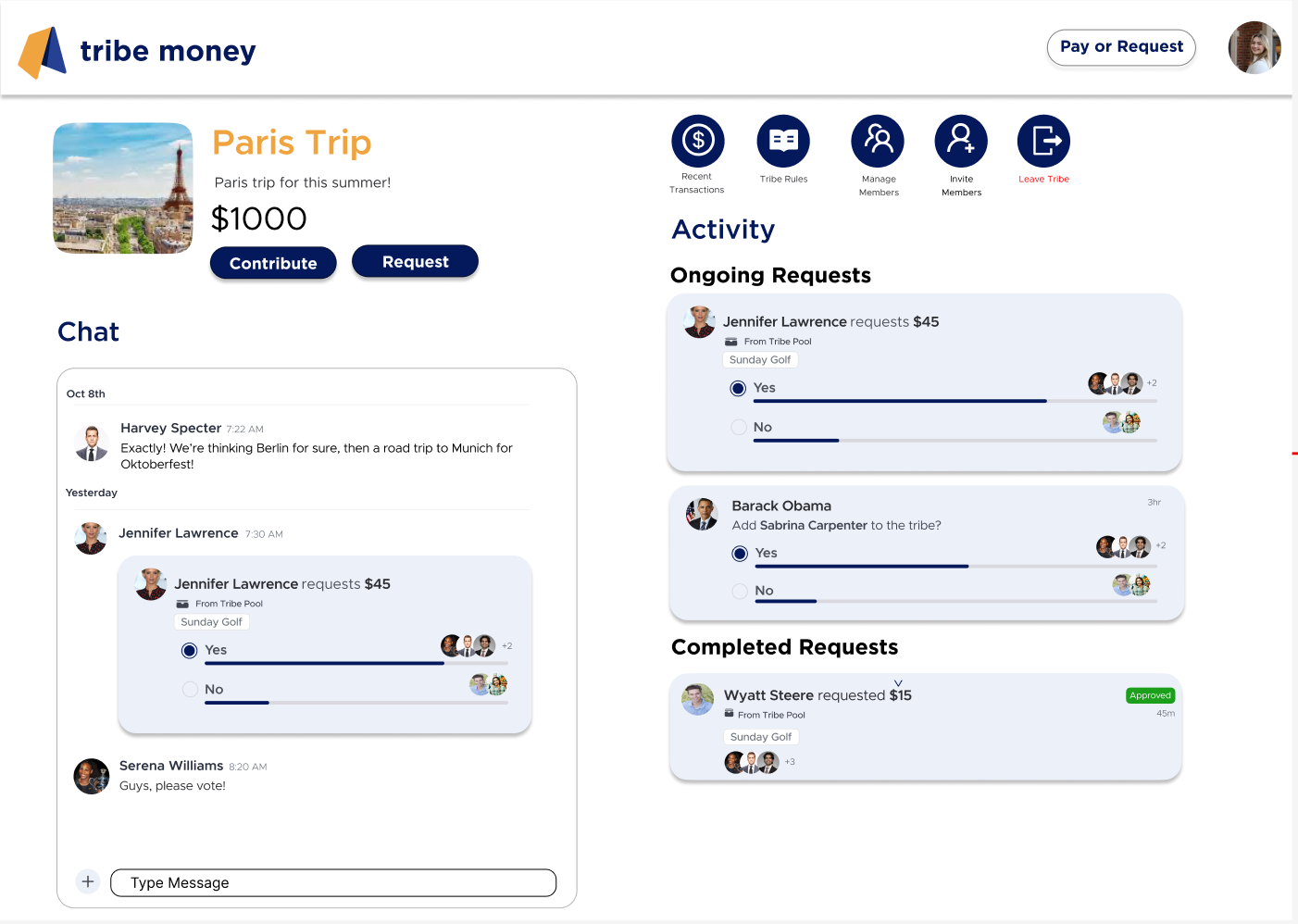
Design Impact: Include activity history, voting progress indicators, and fund visualization to make financial activity easy to understand at a glance. These features reinforce accountability without increasing cognitive load.
Security is a concern
Financial tools require users to trust that their money and data are protected. Participants expressed concern about authentication, account protection, and how pooled funds are managed.
Design Impact: Incorporate authentication flows, MFA support, third-party trusted banking services, and familiar fintech design patterns, along with clear account and settings navigation to reinforce security confidence.
Customization is essential
Groups manage money in different ways depending on context (clubs, sports teams, roommates, events). Users expect tools to adapt to their workflow.
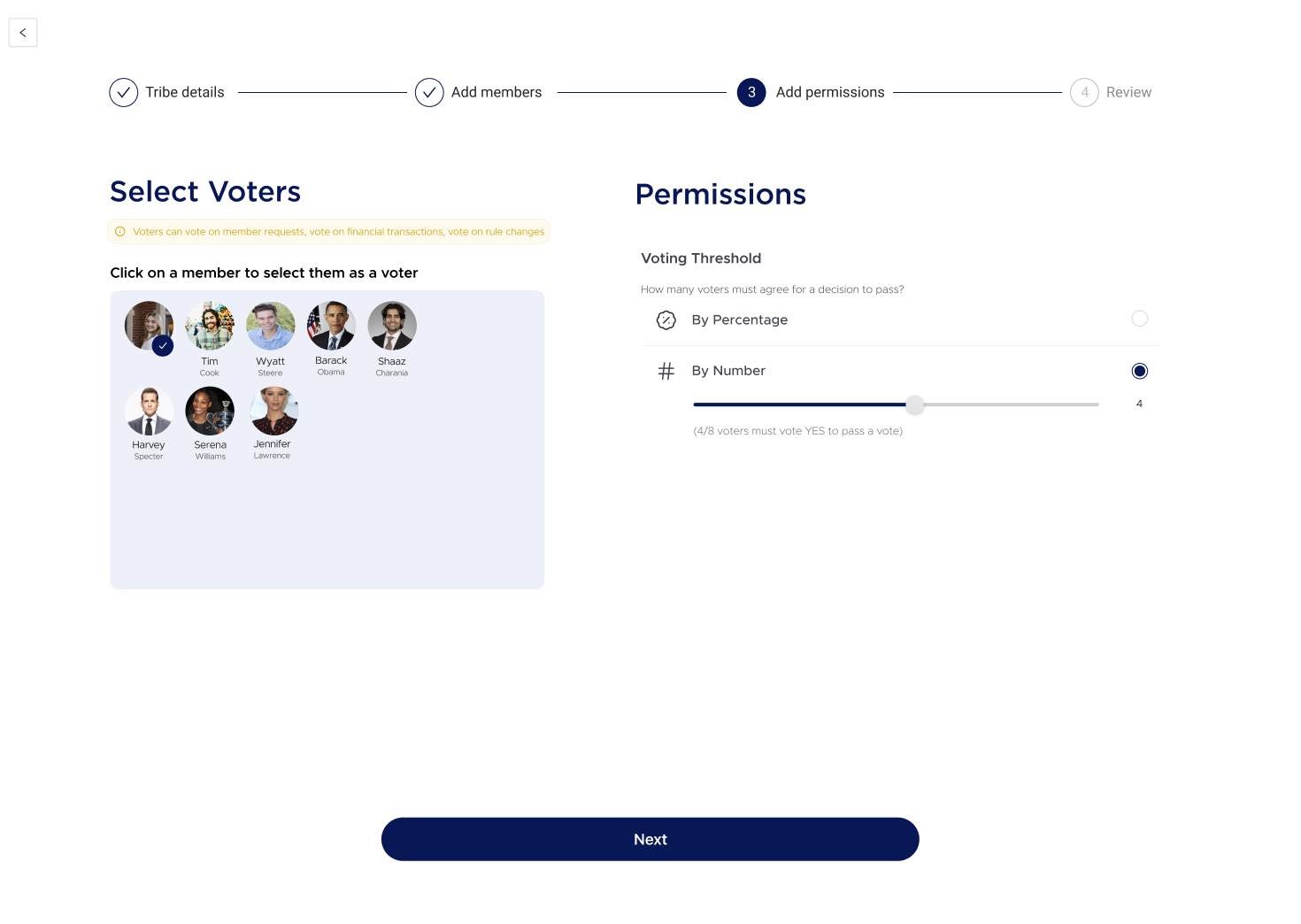
Design Impact: We designed flexible tribe management and voting features, role-based visibility, and configurable request flows to support different group structures and financial practices.
Scalability matters
Group size and financial complexity vary widely, from small roommate expenses to large organizations managing thousands of dollars.
Design Impact: The web-app is structured to support larger financial ecosystems while remaining usable for small groups.
Visual design impacts trust
In fintech products, visual clarity and familiarity strongly influence perceived reliability and safety. Users associate calm colors, structured layouts, and consistent typography with financial trustworthiness.
Design Impact: We maintained Tribe Money’s existing color system and typography for mobile app continuity while using the larger web layout to improve hierarchy, readability, and clarity.
Outcome & Reflection
This project strengthened my product management skills and ability to conduct UX research in complex, real-world product environments involving financial trust, multiple stakeholders, and cross-platform interaction design.
I developed skills in:
User interviewing
Usability testing and research synthesis
Figma and UX design
Designing for trust and transparency
Translating research into product decisions
Stakeholder management
Product planning and scoping
Agile framework
This project reinforced how UX research can shape fintech products by improving clarity, accountability, and user confidence in financial systems. Additionally, collaborating on a product with multiple teams provided real-world experience and improved my adaptability.
The project concluded with a sponsor handoff including research findings, UX documentation, and implementation recommendations. Future work on the Tribe Money web app would focus on continued iteration alongside the existing mobile product and pushing the web experience toward production readiness. Additional improvements could include refining account and dashboard design to better support different user roles and financial contexts.
User Story Prototype Walkthrough (high-fidelity wireframes)
Design Decisions, Constraints, and Collaboration
Research informed several core components:
Dashboard fund visualization
Request creation and voting flow
Centralized transaction history
Role-based visibility and permissions
Cross-platform consistency with mobile app
Because web interfaces offer more screen space, we combined steps from the mobile experience to create more efficient workflows while maintaining clarity. We intentionally simplified flows and removed unnecessary screens (such as a separate alerts page) to reduce friction.
This project involved several constraints:
Aligning with sponsor requirements and roadmap
Met weekly with all facets of the Tribe Money team: UX, Engineering, Product, and Executive
Faced challenges with conflicting opinions between UX and engineering
Required adaptability and quick redirection due to startup environment
Limited timeline for research and iteration
Had to produce high-fidelity prototype quickly to allow time for engineering team
Iterations in design meant changes in production
Progress must align with Capstone class’s deliverables
The engineering team built a functional web application prototype using React, Vite, Typescript, HTML, CSS, Firebase authentication, and backend integration with existing Tribe Money infrastructure.